


Your Stars
Detailed Nakshatra Analysis & Report:
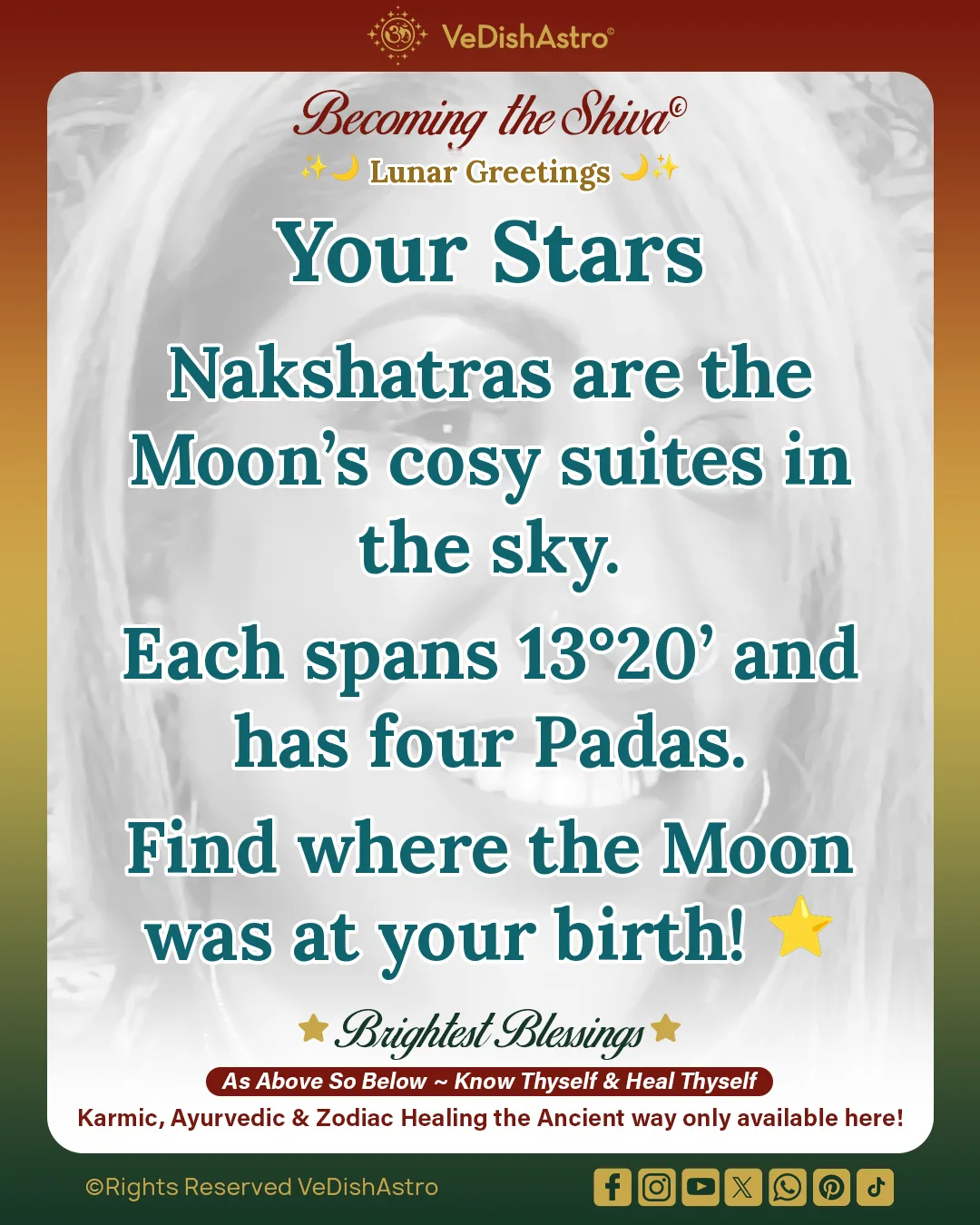
In Vedic and Ancient astrology, the Nakshatras are the Moon’s lunar mansions. Each Nakshatra spans 13°20′ and is divided into four quarters called Padas, each of 3°20′. As the Moon moves through the zodiac, a journey of about 27 days, it spends around 2.3 days in each sign and roughly one day in each Nakshatra. The Moon leads the Nakshatras and the planetary rhythm that shapes our individual destinies. The word Nakshatra is popularly explained as a blend of “Naksha” (map) and “Tara” (star), a stellar roadmap to guide us. Nakshatras are among the oldest parts of Vedic astronomy. The Atharvaveda lists 27 of them, and the Vedanga Jyotisha is the earliest astronomical text to list them.
To find your personal Nakshatra you need your date, year, place and time of birth. With these details an astrologer can show where the Moon stood when you were born, pointing to the constellation that resonates with your soul. Your Nakshatra is your celestial fingerprint, while your horoscope shows the positions of the Sun and Moon at that moment, with insight into your wellbeing and your nature. There is also a 28th Nakshatra, Abhijit. Once prominent in astrological circles, it is not part of today’s 27-part division, yet some wise sages still honour it. With VeDishAstro© and on the path of Becoming the Shiva, you can explore how the ancients across the world saw the heavens at different times.
Cosmic Time in Hindu Mythology
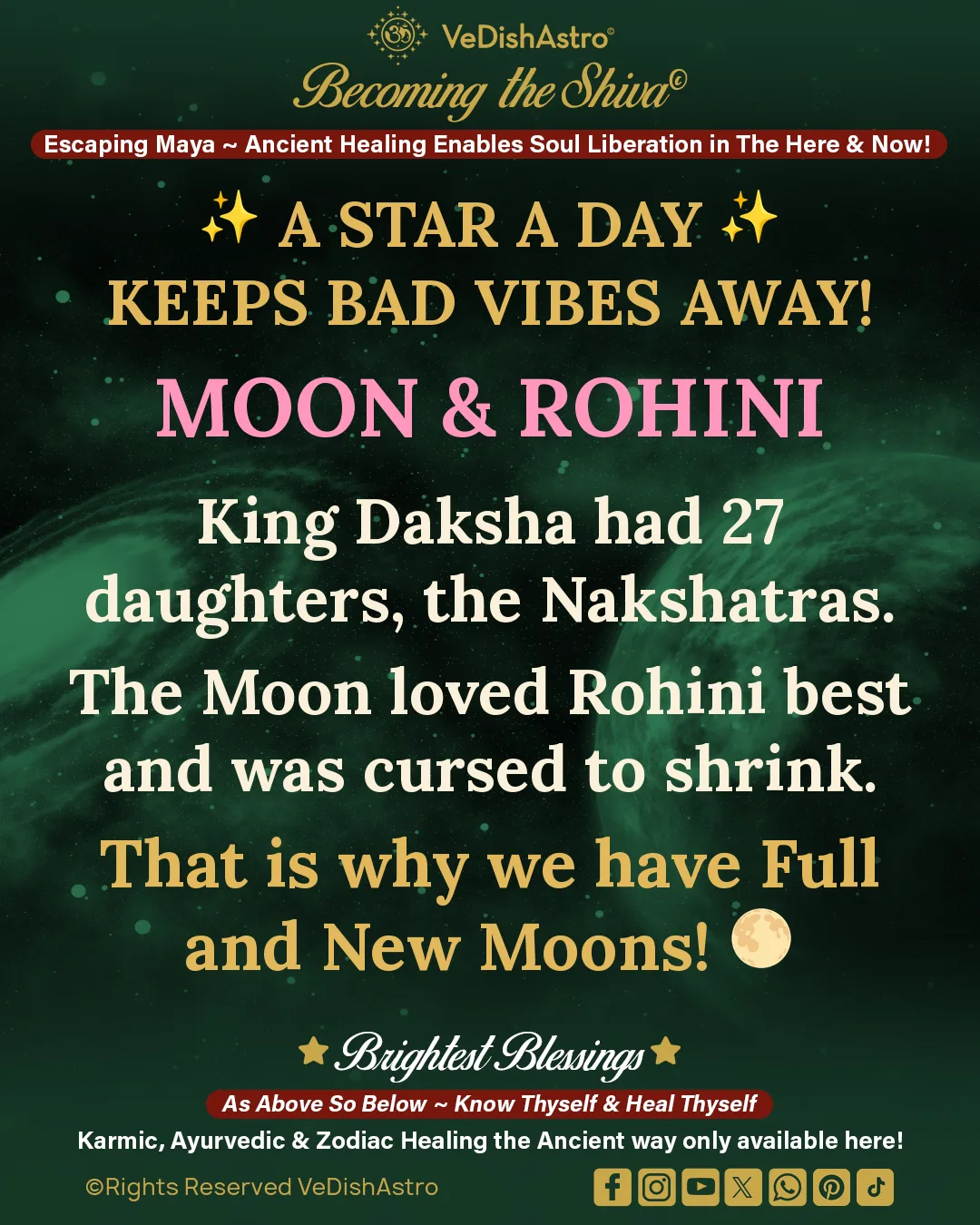
In Hindu mythology, King Daksha was the father of 27 daughters. The young Prince Moon married all of these women, the Nakshatras, but his deepest favourite was Rohini, the queen of his lunar heart. This favouritism did not sit well with the other 26 wives, who complained to King Daksha. The Moon remained devoted to Rohini, which sent Daksha into a rage, and he cursed the Moon to shrink. The others begged Daksha to take back the curse, promising that the Moon would show love to each daughter in turn. He could not fully lift the curse, but he softened it: the Moon would regain his glow over half a month. That is why we observe the cycles of Purnima (Full Moon) and Amavasya (New Moon) as the Moon travels through each Nakshatra. While our focus is on the stars rather than the backstory, this tale gives us a view into the minds of the ancients who told it, and in my view it hints at how closely they watched the Moon’s cycle, long before telescopes.
In the Cosmic Quilt of The Universe
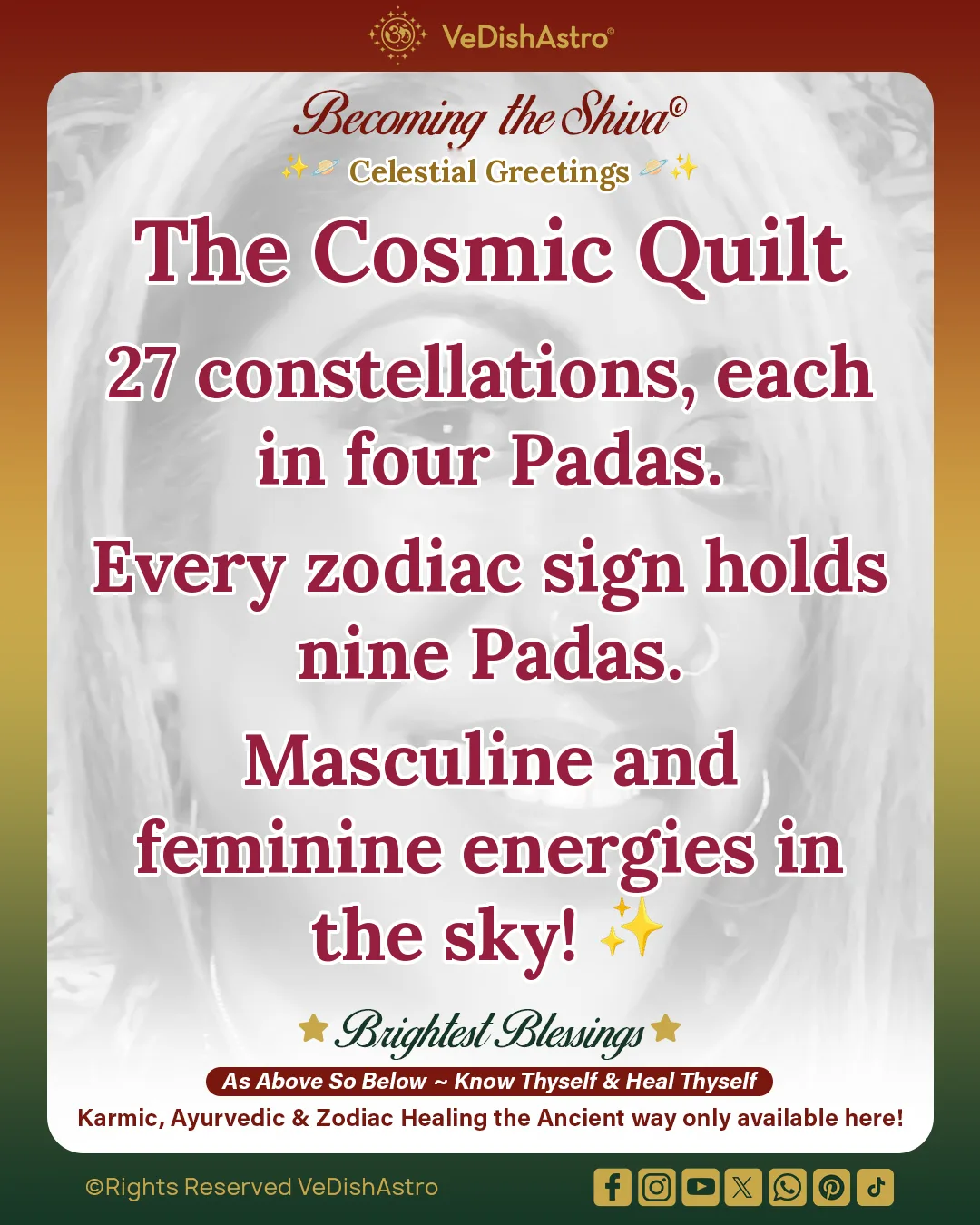
In the sky we find 27 constellations, each divided into four Padas. The Padas begin with Aries and join the Nakshatras to the zodiac signs. Each zodiac sign spans two and a quarter Nakshatras, which makes nine Padas per sign. These Padas reveal the essence of a person’s soul and carry as much meaning as a full zodiac sign.
The Nakshatras are rich in symbolism. They link to planets, life purpose, qualities and even our roles in society, and astrologers weigh many traits when interpreting them. They also divide into masculine and feminine. The masculine Nakshatras are about enthusiasm and energy, and they are Ashwini, Bharani, Pushya, Ashlesha, Magha, Uttara Phalguni, Swati, Jyeshta, Mula, Purvashadha, Uttarashadha, Shravana and Purva Bhadrapada. The feminine Nakshatras are nurturing, radiating warmth and care. They are Krittika, Rohini, Mrigashirsha, Ardra, Punarvasu, Purva Phalguni, Hasta, Chitra, Vishakha, Anuradha, Dhanistha, Shatabhishak, Uttara Bhadrapada and Revati.
When Diving into The Temperament of Nakshatras
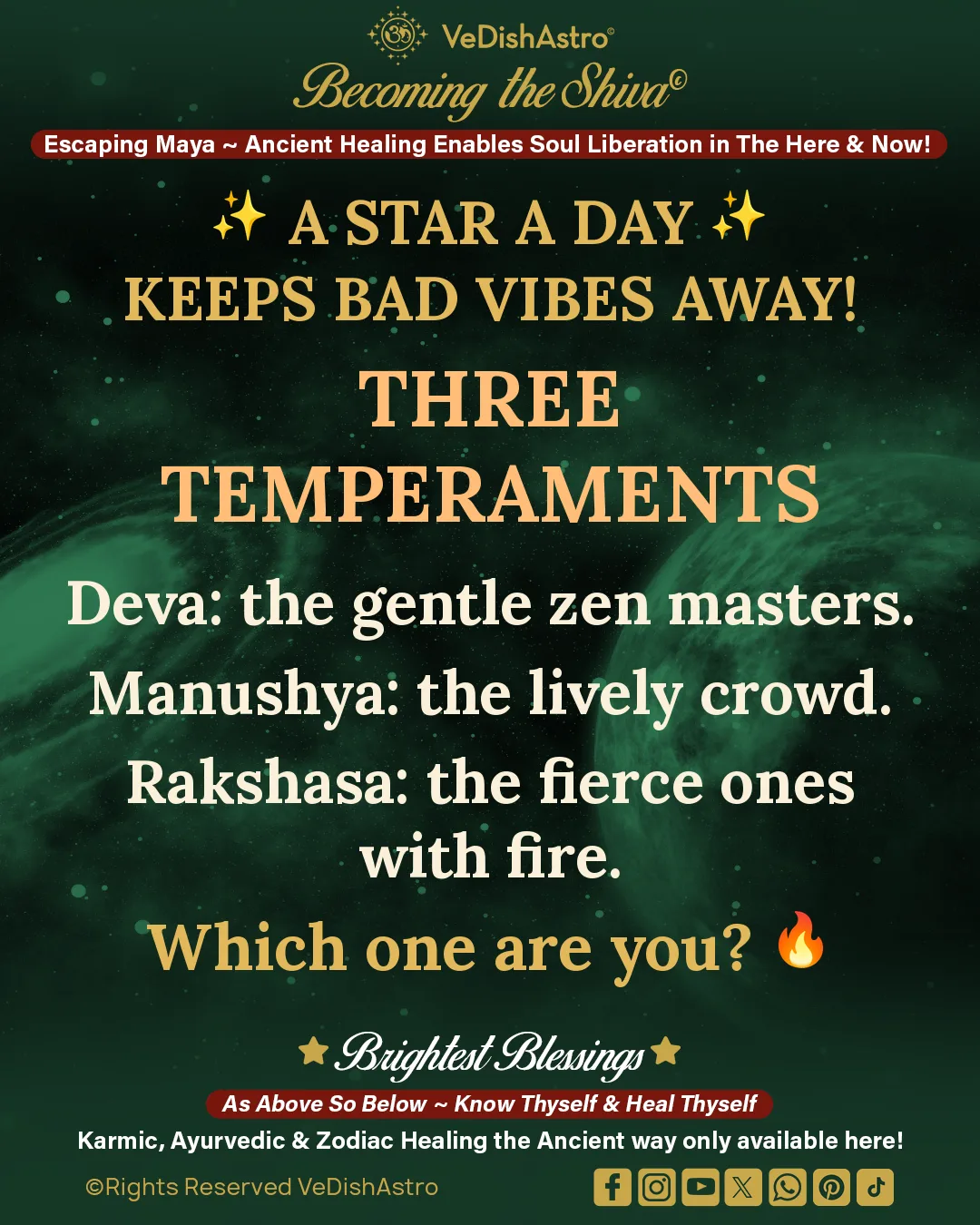
The temperament of the Nakshatras falls into three types: Deva, Manushya and Rakshasa. The Deva Nakshatras are the gentle ones: Ashwini, Mrigashirsha, Punarvasu, Pushya, Hasta, Swati, Anuradha, Shravana and Revati. The Manushya Nakshatras are the lively ones: Bharani, Rohini, Ardra, and the Purva and Uttara Nakshatras of Phalguni, Ashadha and Bhadrapada. These people know how to keep life interesting. The Rakshasa Nakshatras are the intense and fierce ones: Krittika, Ashlesha, Magha, Chitra, Vishakha, Jyeshta, Mula, Dhanistha and Shatabhishak.
When Diving into The Temperament of Nakshatras ~ Continued
If you have many planets in Deva Nakshatras, you probably have a heart of gold. If you resonate with Rakshasa, you may bring the fire! Vedic astrology also links the constellations with spirit animals, and knowing your ascendant opens a route to self-discovery through your totem’s traits. Then there is Guna, which describes how energy flows. In the system I follow, Rajas brings dynamism and runs from Aries to Cancer, Tamas moves into the material world from Leo to Scorpio, and Sattva is about liberation, from Sagittarius to Pisces. So how do the Nakshatras differ from the zodiac signs? Let us find out.
Pretty Canvas Painted With Twelve Zodiac Signs
The sky is not only a canvas of twelve zodiac signs; it is also woven with 27 Nakshatras. Each zodiac sign takes a 30° slice of the sky, while each Nakshatra covers 13°20′. Think of the Nakshatras as the fine detail that adds depth to the zodiac’s grand design.
Now let us turn to the Four Aims of Life: Dharma, Artha, Kama and Moksha. As we look at the Nakshatras in the night sky, they reveal the purpose of our lives.
Dharma ~ is about fulfilling your responsibilities and finding soul satisfaction in your daily work.
Artha ~ is the pursuit of wealth and security.
Kama ~ is the pursuit of your heart’s desires.
Moksha ~ is the great release, where your spirit is set free.
Each aim also carries an elemental energy: Dharma is fiery passion, Artha is grounded like earth, while Kama and Moksha flow like water.
This Ancient Tapestry of Knowledge
This ancient body of knowledge, known as Jyotish, traces its roots to India and has flourished for thousands of years. It embodies the belief that the stars and planets influence our lives on Earth. The word “Vedic” comes from the Vedas, the revered ancient scriptures of Hinduism, which lay the foundation of this astrological system. Deeply interwoven with Hinduism, the Vedas shed light on the astrological events that shape our lives. In India, Vedic astrology holds a revered place, particularly in matchmaking for marriage. Traditional Indian families often consult astrologers who analyse birth charts to help arrange unions, and this age-old practice continues as one of the most cherished applications of Vedic wisdom. While Western astrology looks mainly to the Sun, Vedic astrology turns to the Moon. As our nearest celestial companion, the Moon is believed to hold the most profound energetic influence, acting as a conduit to our past lives and future journeys. In Vedic astrology, timing and compatibility rest largely on a person’s Moon sign and its position. The Moon symbolises the mind, the emotions and the maternal origins from which we enter this world. Our karma moves with the stars and planets, and understanding grows through careful analysis. Our ancestors observed the connections between celestial alignments and earthly events, from shifts in the environment to the nuances of human behaviour, and recorded their observations to be passed down through the ages. Vedic astrology offers guidance, wisdom and direction to those who feel adrift or uncertain on their unique paths.
Unlocking The Secrets of Nakshatras in Astrology
Unlocking the secrets of the Nakshatras ~ In Vedic and ancient astrology, the Nakshatras are the stars of significance. They guide how we think, perceive and move through life, and they help predict the Dasha periods in your horoscope. Astrologers rely on Nakshatras for accurate predictions, as they blend zodiac signs with ruling energies and add insight into personality. Each Nakshatra has its own character and power, thanks to the nine celestial lords who bestow blessings. They are the realms where karmic results gather, illuminating your traits and dreams while steering you towards your ambitions. When matching charts (Kundli), the Nakshatras reveal the fortune of a couple. In short, Nakshatras are the key to Vedic and Ancient astrology, helping you decode the layers of your personality and karmic connections while you navigate the major Dasha phases in your birth chart. You will receive a detailed report on all the Nakshatras in your chart, with a full Analysis and Report, within 15 days of booking. Would you like more information, or to ask about dates and availability? Please use the contact form before booking. Thank you.
Hey, why not join us on your favourite social media channel or page? We’d love to see you there! 💛
Sources
Our YouTube channel
Nakshatra: span 13°20′, Pada 3°20′, Atharvaveda list, Vedanga Jyotisha
Deva, Manushya and Rakshasa groups (Dekho Panchang)